ART-034
The Map Table
The Second World War, All Theatres
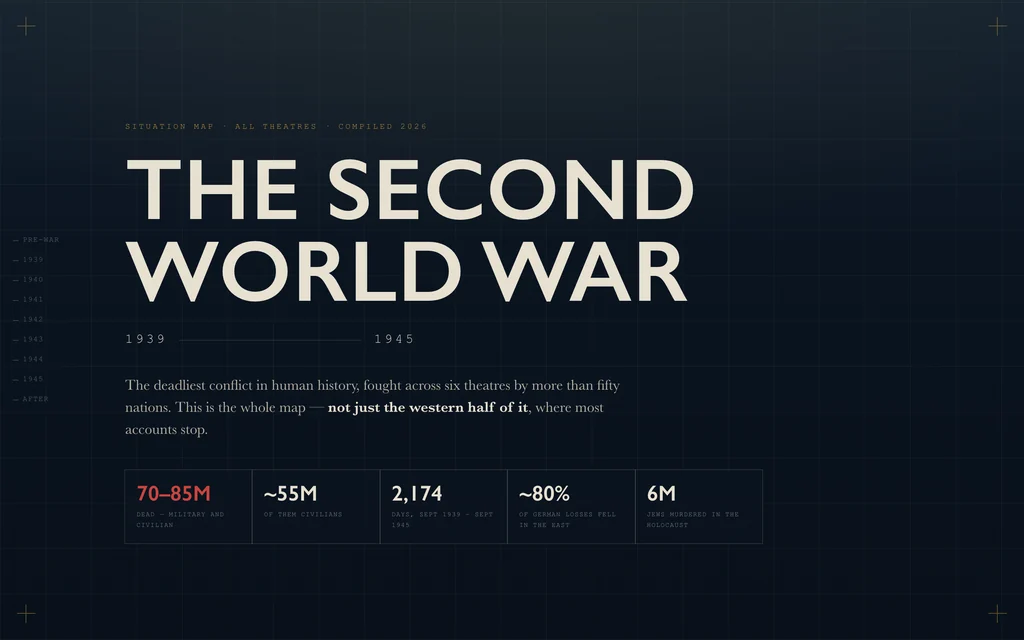
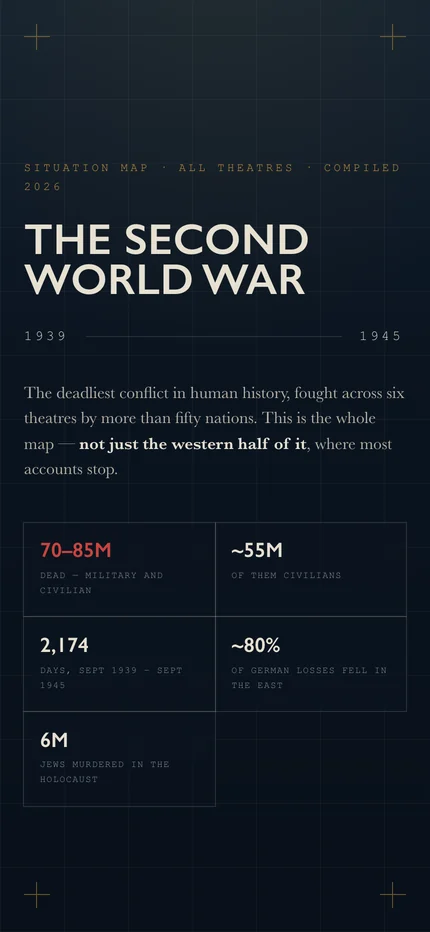
Fourteen sheets, thirty-three archival photographs and three built diagrams, laid out as a Cabinet War Rooms map table: chart-room navy under a lamp, map-paper insets, and a strict cartographer's colour law — Allied blue, Axis red, brass for the annotation. Gill Sans was the actual institutional typeface of wartime Britain, so it sets the sheets here, against Baskerville and a Courier that stands in for the teleprinter. The one look this subject always gets — sepia photographs, olive khaki, stencilled capitals — is the one look it does not get.
It exists to correct a proportion. The war is remembered in English as D-Day, the Blitz and the Pacific; in fact roughly four in five German military deaths happened fighting the Soviet Union, and two countries — the USSR and China — account for more than half of everyone who died. The casualty chart at the centre of the room is built to make that visible in one glance, with Britain and America sitting near the bottom of it under a label reading “the war most of us were taught.”
What to take from it: every contested figure carries its range rather than a false single number, because in much of the east there was nobody left to count and afterwards no government with an interest in counting honestly. Dresden is given at 22,700–25,000 from the city's own commission, against the 500,000 of Nazi propaganda; Majdanek is given at about 78,000, revised down from an official 360,000. Honest history moves in both directions, and the imprecision is not a footnote to this story — it is the story.